Serra Negra
The Disappearance of Josef MengeleSerra Negra is the Brazilian setting of Josef Mengele’s longest documented refuge with the Stammer family, a farmstead where an isolated landscape became both protection and confinement. From his arrival in 1962 until the Stammers decided to leave in 1968, the farm sheltered his concealed identity, elaborate precautions, and growing dependence on his hosts.
Setting and Relocation
The Stammers’ move followed a dispute over the conditions of their earlier arrangement in Nova Europa. Geza Stammer eventually accepted his wife Gitta’s demand for a more viable home and passed the family’s terms to an Austrian intermediary in São Paulo. The Mengele family agreed to provide half the capital for another farm; the Stammers were to find the property and sell their Nova Europa land to cover the balance. A few weeks later, the Stammers and the man they sheltered moved to an isolated farmhouse in Serra Negra, with forty-five hectares around it. The relocation took place five months before Mossad found Yossele.
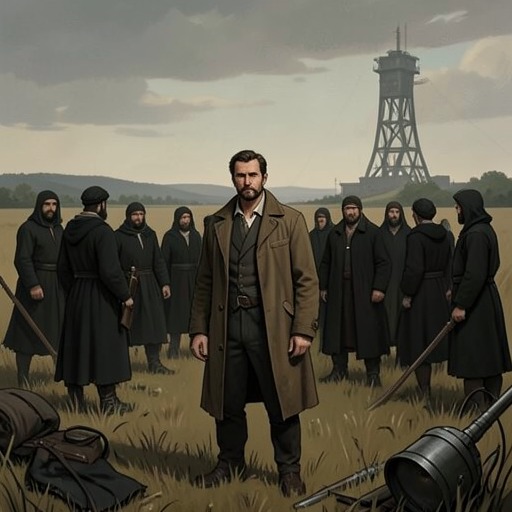
The setting offered a marked change from the harsher surroundings they had left. Serra Negra was a spa town founded by Italian settlers, and the farm stood on a hill overlooking the plain. Woods, hills, and rocky ground framed the property; behind the farm and coffee plantation, cliffs and dense forest formed a natural barrier. The account emphasizes the contrast between this sheltered landscape and the exposed life of a fugitive: the farm seemed safer than Mengele’s previous hiding places, but its isolation also narrowed the world he could enter.
A Working Farm and Household
The property was not simply a hideout. Its agricultural work gave Mengele a practical role in the Stammers’ household. Before the move, he operated on a cow with an abdominal hernia, closing the incision with enough skill that the animal was left with only a small scar and recovered well. His ability to treat livestock helped the Stammers avoid veterinary expenses. He also devised a pulley arrangement to crush an anthill, spending hours calculating and adjusting the mechanism; the termites later established a nest elsewhere. These episodes present the farm as a place where his technical attentiveness could be useful, even as the care he devoted to such tasks contrasted with the uncertainty of his concealed life.
Gitta’s interest in Mengele was entangled with the household’s finances and daily needs. She valued his competence on the farm and his usefulness in managing its workers, while his presence brought money from his supporters. She could obtain further funds by complaining to Gerhard, and the household acquired new clothes, leather satchels for the boys, a bed, and electricity. The arrangement therefore linked concealment to material dependence: Mengele needed the Stammers’ shelter, while their household benefited from the resources attached to his presence.
Refuge and Surveillance
Mengele treated the farm as a defensible enclosure. He did not leave after arriving in Serra Negra and saw almost no one beyond Gerhard, who brought newspapers, books, laxatives, and, occasionally, classical music records. Before the Stammers received rare visitors, Mengele questioned them about who the visitors were, where they came from, and how long they had been known. Even when reassured, he stayed hidden. On Saturdays, he withdrew when friends of the boys came to visit. To them he was Uncle Peter, an eccentric Swiss man who was not to be photographed or discussed outside the farm.
His precautions shaped the grounds as much as they shaped the household’s behavior. At his request, the Stammers hired a janitor, whose wages his family would pay. Mengele also kept about fifteen stray dogs, trained to accompany him into the jungle; Cigano, their leader, stayed close to him. A six-metre lookout tower became the farm’s most conspicuous defensive feature. Built by a laborer under the pretext of bird-watching, it was later replaced with stone because of the risk of termites. Mengele watched the road and the dirt track leading to the farm through binoculars, sometimes from the tower in a beekeeper’s outfit. In clear weather, he could see as far as Lindonia, five miles away. His dogs stood guard when he went to bed.
The same farm that promised safety became the perimeter of a restricted life. In September 1967, five years after arriving, Mengele was still there, seized by anxiety after reading about Albert Speer’s release from prison and public contrition. The account sets his fears against the physical structure of his refuge: he could climb the tower and scan the countryside, but he could not freely rejoin the world beyond it. His repeated listening to Wagner and Bach, supplied on records by Gerhard, belongs to this enclosed routine, alongside the constant scrutiny of roads, visitors, and news.
Tensions and Departure
Serra Negra also contained an unstable domestic arrangement. Geza and Mengele baited and insulted one another, while Gerhard repeatedly intervened to calm disputes. After Geza reconciled with Gitta, Mengele responded by making a show of his relations with farm employees. The farm’s seclusion therefore did not remove conflict; it concentrated the household’s rivalries within a shared space in which Mengele depended on the people he antagonized.
Events outside the property sharpened that dependence. In 1967, Gerhard came to Serra Negra after Franz Stangl’s arrest in São Paulo and discussed supporting the former camp commandant. Mengele persuaded him to restrain his activities, fearing that they could draw police attention to the farm. That June, Mengele also followed the Six-Day War on a television set Geza had given his sons. The farm’s isolation was thus not complete: newspapers, visitors, radio, records, and television carried news into the refuge, where it repeatedly unsettled him.
In October 1968, the Stammers planned to sell the farm and abandon agriculture. Geza had been promoted and wanted to live nearer his workplace; Mengele refused to leave what he treated as his stronghold. His supporters explored the possibility of moving him to Bolivia, but he would not accept another change of country or the uncertainty of relying on a new host. The Stammers, meanwhile, needed the proceeds from selling Serra Negra to acquire a larger property. Mengele finally had to follow them. They moved in early 1969 to a property in Caieiras, about thirty kilometres from São Paulo. At Serra Negra, the lookout tower and dogs had made the farm a fortress; the decision to sell showed that its security ultimately rested on a household whose plans he could not control.